
No products in the cart.










FindHolidays Life and Travel Growth Guide · Chennai
The Growth Flow: Learn, Earn, Save, Invest—and Live the Experiences You Value
A practical life framework for turning knowledge into useful work, income into stability, stability into choice, and choice into meaningful travel—without treating money or travel as the final destination.
Knowledge can create income. Income can create options. When those options are managed with purpose, they can create a richer life—not only a larger bank balance.

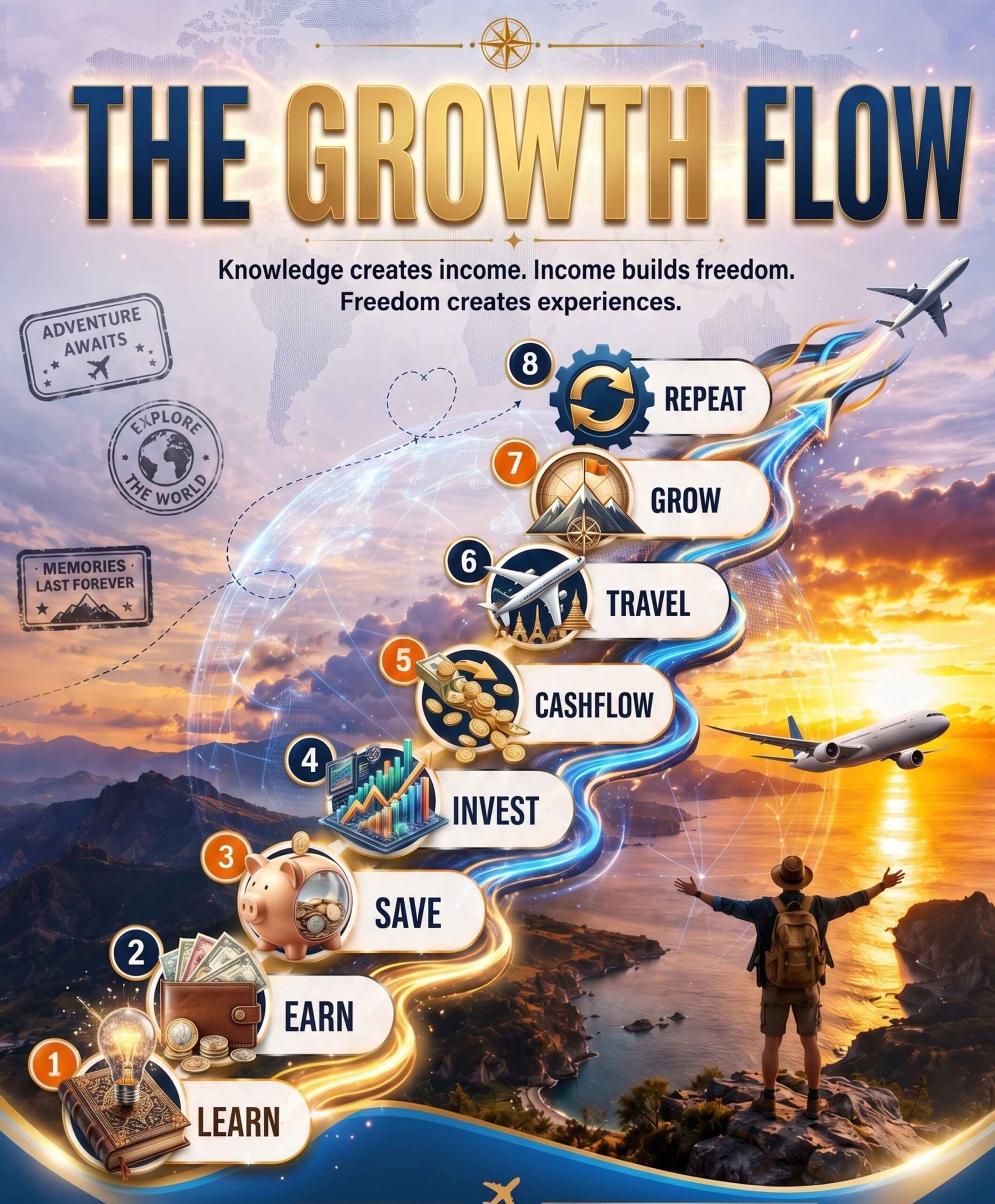
The Growth Flow is an eight-stage way to think about progress: learn, earn, save, invest, improve cash flow, travel, grow and repeat. It is not a promise that every person will become financially free through one fixed formula. It is a decision framework that connects personal development, money management and life experience in a more responsible order.
The concept begins with a simple observation. Knowledge becomes powerful when it is applied. Applied knowledge can create value. Value can create income. When income is managed well, it can create stability and choices. Those choices may include meaningful travel, time with family, rest, learning, contribution or a new personal goal. The final step is not to stop—it is to return to learning with greater experience.
Growth Is Not Only About Earning More
Income is important because it supports food, shelter, health, education, family responsibilities and future choices. However, income alone does not describe growth. A person can earn more and still feel trapped by uncontrolled spending, debt, exhaustion or a life that has no room for experiences.
A more complete definition of growth includes three capacities:
Financial capacity
The ability to meet obligations, handle disruptions, work toward future goals and make decisions without depending entirely on the next salary or sale.
Time capacity
The ability to protect some hours, days or seasons for rest, family, learning, health and experiences—not only for continuous work.
Experience capacity
The ability to turn available money and time into moments that expand perspective, strengthen relationships or create lasting memories.
These capacities influence one another. Better skills may improve earning potential. Better financial habits may reduce anxiety. Reduced anxiety may support clearer decisions. Meaningful travel may restore energy, deepen relationships or reveal new ideas. Those experiences then return to the beginning of the cycle as learning.
A strong life does not only produce money. It produces knowledge, choices, resilience, experiences and the wisdom to begin again.
The Eight Stages of the Growth Flow
The poster presents the steps as a rising path, but each stage has a practical purpose. Skipping a stage can make the next one unstable.
Learn: Build Knowledge That Can Be Used
The purpose: increase your ability to solve problems, make decisions and create value.
Useful learning has three layers: an earning skill that can improve your work, a money skill that improves how you manage income, and a life skill that improves communication, health, travel or relationships.
Do not confuse: collecting courses with progress. Learning becomes part of the flow only when it changes what you can do, decide or deliver.
Earn: Convert Value into Income
The purpose: receive income by helping an employer, customer, client or community achieve something valuable.
Growth question: which skill, service, product or responsibility can you perform better, faster, more reliably or more creatively?
Do not confuse: revenue with usable income. What matters is the amount left after work-related costs, taxes, obligations and essential personal expenses.
Save: Protect the Progress You Already Made
The purpose: create distance between an unexpected expense and a financial emergency.
Saving can support different jobs: a safety buffer, an upcoming payment, a travel goal, education, equipment or another planned purchase. Keeping those goals separate makes the money easier to understand.
Do not confuse: saving with fear-based hoarding. Savings should protect life and prepare for goals, not prevent every meaningful experience forever.
Invest: Give Long-Term Goals Time to Develop
The purpose: place suitable long-term money into assets or opportunities that match your objective, time horizon and ability to accept risk.
Investing is not guaranteed growth. Every investment requires research, an understanding of risk, appropriate diversification and periodic review. Money needed soon should not be exposed casually to unsuitable volatility or illiquidity.
Do not confuse: investing with chasing tips, quick returns or products you cannot explain in simple language.
Cash Flow: Create Breathing Space Between In and Out
The purpose: understand how money moves through your life each month.
Positive personal cash flow means income is greater than outgoing commitments during the measured period. That remaining margin can support safety, future goals, learning and experiences. A high income with uncontrolled outflow may produce less freedom than a moderate income managed with clarity.
Do not confuse: cash flow with guaranteed “passive income.” First improve the reliability of current income and the visibility of expenses.
Travel: Convert Part of Freedom into Experience
The purpose: use a planned portion of available money and time to experience places, people, cultures, nature and shared memories.
Travel belongs in the flow because a well-planned life should contain something worth working toward. It can also develop adaptability, confidence, observation, patience and gratitude.
Do not confuse: meaningful travel with spending beyond your capacity to prove success online. A smaller journey without financial stress can be more valuable than a luxury trip financed by pressure.
Grow: Return with More Than Photographs
The purpose: convert work, mistakes, money decisions and travel experiences into better judgment.
Growth may appear as a new skill, stronger relationship, improved confidence, clearer priorities, healthier boundaries or a decision to simplify. Not every gain can be measured in currency.
Do not confuse: growth with permanent speed. Reflection, recovery and changing direction can also be forms of progress.
Repeat: Begin Again from a Higher Level of Awareness
The purpose: create a sustainable cycle instead of depending on one motivational moment.
After a review, you may return to learning with better questions, earn through more useful skills, save for a clearer purpose, invest more appropriately, improve cash flow and design a more meaningful next experience. Repetition creates power only when it includes reflection.
The Growth Flow Decision Table
Use this table as a practical review. It shows what each stage is meant to produce and what can quietly interrupt the flow.
| Stage | Question to ask | A useful action | A common interruption |
|---|---|---|---|
| Learn | What useful ability am I building? | Choose one skill and apply it in a real project. | Consuming information without practice. |
| Earn | Whose problem am I helping solve? | Improve quality, reliability or communication. | Focusing only on money without improving value. |
| Save | What future problem or goal is this money for? | Name separate savings goals. | Saving without purpose or spending every surplus. |
| Invest | When will I need this money, and what risk can I accept? | Research regulated options and seek qualified guidance when needed. | Following tips, promises or unsuitable products. |
| Cash flow | What remains after the month’s commitments? | Track recurring inflows and outflows. | Ignoring small repeated expenses or irregular costs. |
| Travel | What experience matters enough to plan for? | Create a dedicated travel fund and realistic itinerary. | Using debt or exhausting every financial buffer. |
| Grow | What changed in my thinking or behaviour? | Write down one lesson and one adjustment. | Moving to the next goal without reflection. |
| Repeat | What should be continued, improved or stopped? | Run a monthly or quarterly review. | Repeating activity without learning from results. |
Why the Growth Flow Is a Cycle, Not a Straight Ladder
A ladder suggests that every step is completed once and left behind. Real life does not behave that way. People continue learning while earning. They may save for one goal while investing for another. A family may temporarily reduce travel to rebuild its safety buffer. A business owner may return to skill development after a market change.
You can move backward without failing
Returning from “invest” to “save” after an emergency is not defeat. It is the system responding to life.
Several stages can operate together
A person can learn during a trip, earn while building a business, save for a short-term goal and invest for a distant one.
The weakest stage affects the whole cycle
Strong earnings cannot fully compensate for invisible outflow. Strong savings cannot replace learning forever. Travel without planning can damage later stages.
Every repetition should become more personal
The first cycle may focus on stability. A later cycle may focus on family, time freedom, contribution, health or a once-in-a-lifetime journey.
The FindHolidays GROWTH Compass
The eight-step flow explains movement. The GROWTH Compass helps decide direction.
Goal clarity
Define what “better” means now: stability, education, a family holiday, career change, business growth or more personal time.
Reliable income
Strengthen the quality and dependability of existing income before chasing many uncertain streams.
Outflow awareness
Know what leaves regularly, what is essential, what is flexible and which irregular costs need preparation.
Wise future building
Match saving and investing decisions to the goal, time horizon, risk and need for access.
Travel with purpose
Choose experiences that suit your values and current capacity rather than copying someone else’s lifestyle.
Habitual review
Review the system regularly so that changes in income, family, health or priorities are reflected in the plan.
Why Travel Belongs in a Responsible Growth Plan
Travel is sometimes placed at two unhealthy extremes. At one extreme, people are told to postpone every experience until they reach an undefined level of success. At the other, travel is promoted as something worth any financial sacrifice. The Growth Flow uses a middle path: protect essentials and future goals, then intentionally fund experiences that matter.
Travel gives effort a visible purpose
A named journey can make saving feel more meaningful than a vague instruction to “spend less.”
Travel can expand useful abilities
Planning routes, navigating unfamiliar places, adapting to changes and communicating across cultures can strengthen confidence and judgment.
Shared travel can strengthen relationships
Couples, families and friends often remember the conversations, problems solved and unexpected moments more than the formal itinerary.
Rest can protect long-term performance
A thoughtful break can create mental distance from routine and help people return with renewed attention. It should complement—not replace—healthier daily boundaries.
A Four-Pocket System for Money and Experiences
This is not a fixed percentage formula. It is a simple way to give different jobs to money so one goal does not silently consume another.
1. Essentials
Regular living costs and committed obligations that keep daily life functioning.
2. Safety
A buffer for disruptions, repairs, urgent travel, health-related needs or temporary income changes.
3. Future
Longer-term saving or appropriate investing connected to defined goals and timelines.
4. Experience
A dedicated amount for travel, celebrations, learning experiences and memories without disturbing the other pockets.
When income arrives, the exact allocation may change according to responsibilities. The useful principle is separation. A travel fund is easier to use confidently when it is not mixed with rent, emergency money or near-term commitments.
How the Growth Flow Looks at Different Life Stages
The same flow can serve different people without pretending that their income, responsibilities or opportunities are equal.
Student or career starter
The first cycle may focus on practical skills, employability, disciplined saving and a modest first journey. The main investment may be time, training and useful tools rather than complex financial products.
Salaried professional
The cycle may focus on skill growth, salary progression, expense visibility, a safety buffer, long-term goals and a planned annual travel fund.
Entrepreneur or freelancer
The flow needs clearer separation between revenue, business expenses, tax obligations and personal income. Travel should be planned around cash-flow variability and business continuity.
Couple or family
Growth becomes a shared conversation about responsibilities, education, health, parents, housing, future goals and the experiences the family wants to remember together.
A 30-Day Growth Flow Reset
This short reset is designed to produce clarity, not a complete financial transformation in one month.
Days 1–5
Map the current flow
List income sources, essential commitments, recurring expenses, debts, savings goals, investments and upcoming travel or family plans. Do not judge the numbers yet.
Days 6–10
Choose one useful learning goal
Select a skill that can improve work, money decisions or travel planning. Define one real application, not only a course to watch.
Days 11–15
Find one cash-flow improvement
Review one recurring expense, one avoidable leak or one opportunity to improve income through stronger value or communication.
Days 16–20
Name the money pockets
Separate safety, future and experience goals according to your responsibilities. Even small, clearly named amounts create better visibility.
Days 21–25
Design one meaningful experience
Choose a realistic day trip, domestic holiday or international goal. Estimate the full cost, time required and reason it matters.
Days 26–30
Review and repeat
Write what worked, what felt difficult and what should continue next month. The goal is a repeatable system, not a perfect first cycle.
Eight Mistakes That Break the Growth Flow
1. Learning without producing
Knowledge stays disconnected from growth when it never becomes a project, service, improved decision or solved problem.
2. Earning without visibility
Income can increase while freedom decreases if obligations and repeated expenses grow unnoticed.
3. Saving without a name
Unlabelled savings are easier to spend because they have no clear purpose or timeline.
4. Investing before understanding risk
A product should not be chosen only because another person earned from it or because its recent performance looks attractive.
5. Confusing sales with cash flow
Business revenue is not personal spendable money after costs, taxes, refunds, delayed payments and future operating needs.
6. Using travel as proof of success
A journey becomes less meaningful when it creates months of hidden pressure only to look impressive for a few days.
7. Treating growth as constant speed
Recovery, reflection and choosing fewer priorities can protect progress better than permanent urgency.
8. Repeating without reviewing
A cycle compounds only when lessons from the previous round change the next decision.
How to Use This Concept Without Turning It into Financial Advice
The Growth Flow is an educational lifestyle framework. It does not recommend a particular security, mutual fund, deposit, insurance product, loan or investment return. Financial choices differ according to income stability, debt, dependants, taxes, goals, time horizon, liquidity needs and risk tolerance.
Before investing, understand the product and its risks, use official investor-education resources, verify that relevant intermediaries are regulated, and seek advice from an appropriately qualified professional when the decision is beyond your knowledge. You can explore the official SEBI Investor education website for general investor-awareness material.
Related FindHolidays Resources
Frequently Asked Questions
What are the eight steps in the Growth Flow?
The eight steps are learn, earn, save, invest, improve cash flow, travel, grow and repeat. The order protects stability before experience while keeping the cycle flexible enough for different life stages.
Does the Growth Flow guarantee financial freedom?
No. It is a planning framework, not a guarantee. Income, responsibilities, risks, health, economic conditions and personal opportunities differ. The framework is meant to improve clarity and decision-making.
What is positive personal cash flow?
For a measured period, positive personal cash flow generally means money coming in is greater than the money going out. The remaining margin can support savings, future goals, learning or experiences.
Should travel come before investing?
There is no universal order for every rupee. Near-term travel money and long-term investment money serve different purposes. Essential obligations, safety needs, time horizon and risk should be considered before deciding how to allocate money.
Can travel be part of personal growth?
Yes, when it is planned responsibly. Travel can develop adaptability, observation, communication and perspective, while also creating shared memories. However, travel should not be used to hide financial stress or exhaustion.
How can I save for travel without disturbing other goals?
Create a separate travel fund, estimate the complete trip cost, choose a realistic timeline and contribute according to your capacity. Do not mix the travel fund with money required for essential bills or urgent needs.
What should I learn first in this cycle?
Choose one skill that can improve your work or income, one money-management concept that improves decisions, and one life skill that supports communication, health or travel. Apply at least one of them in a real situation.
How can FindHolidays help with the travel stage?
FindHolidays can help travellers compare destinations, build realistic itineraries and arrange travel components such as flights, hotels, transfers, sightseeing, relevant visa assistance and travel insurance according to current availability.
What Experience Are You Growing Toward?
Share the destination or experience you want to build into your life, your preferred travel month, number of travellers and approximate budget. Our Chennai travel team can help turn the travel stage of your Growth Flow into a practical itinerary.
FindHolidays · Anna Nagar, Chennai, Tamil Nadu · info@findholidays.in · +91 99425 49191