
No products in the cart.









FindHolidays Events & Group Travel · Chennai
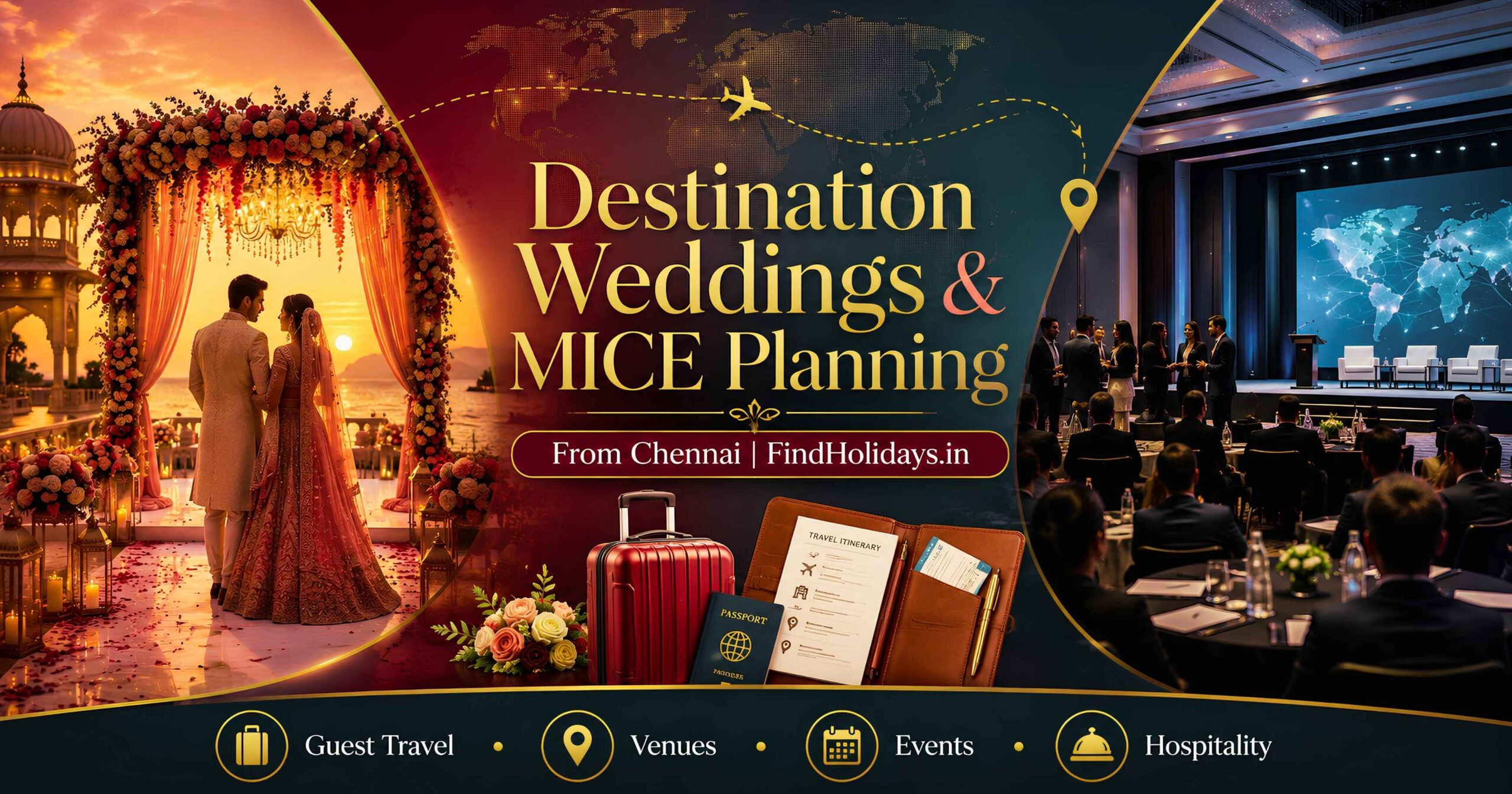
Destination Weddings & MICE Planning from Chennai
A practical guide to planning destination weddings, meetings, incentive travel, conferences, exhibitions, corporate retreats and milestone celebrations—without losing control of guest travel, budgets, responsibilities or backup plans.
Quick answer: successful destination events begin with a clear purpose, realistic guest movement, a defined scope of work and one accountable planning system. The venue matters, but access, accommodation, contracts, permissions, production, food, safety and communication decide how the event actually feels.
One planning system · two event journeys✦
Destination Wedding
Guest travel, rooms, ceremonies, hospitality, vendors and celebration flow.
MICE & Corporate Events
Delegates, agendas, production, branding, movement and measurable outcomes.
Destination wedding and MICE planning from Chennai requires more than selecting a beautiful venue. A wedding may need guest arrivals from several cities, room allocations, ceremony timings, elderly-friendly movement and vendor coordination. A corporate event may need delegate registration, meeting rooms, airport transfers, audiovisual production, branding, reporting and a clear business objective.
Both types of events share one truth: the guest experiences the entire journey, not only the stage. A well-designed invitation cannot repair a missed airport pickup. A luxury venue cannot compensate for unclear room arrangements. A powerful conference agenda can lose impact when delegates spend the day solving transport and check-in problems. Good planning connects travel, hospitality and event delivery into one understandable system.
Four Service Areas That Should Work Together
A destination celebration or corporate gathering becomes easier to control when services are grouped into clear workstreams. The final agreement can include all or selected parts of these areas.
Destination weddings and milestone events
Typical scope: venue research, guest accommodation, ceremony movement, hospitality desks, transfers, vendor schedules, pre- and post-event functions, family communication and honeymoon extensions.
Meetings, incentives, conferences and exhibitions
Typical scope: delegate travel, hotel contracting, meeting spaces, registration flow, production coordination, branded movement, team activities, gala evenings and reporting requirements.
Flights, hotels, visas and local movement
Typical scope: flight options, group manifests, rooming lists, airport pickups, coach planning, visa-document guidance, travel insurance options, special meals and accessibility requests.
Reunions, anniversaries and social groups
Typical scope: destination stays, shared meals, private experiences, sightseeing, celebration venues, family-friendly pacing and optional activities for different age groups.
Scope clarity protects the event: “Complete planning” can mean different things to different people. Ask for a written responsibility matrix showing who handles travel, rooms, venue, permits, décor, catering, production, payments, guest questions and emergency decisions.
Destination Wedding Planning and MICE Planning Are Not the Same
They use some of the same logistics, but the purpose, decision-making and success measures are different. Treating them as identical can create avoidable problems.
| Planning area | Destination wedding | MICE or corporate event | Shared requirement |
|---|---|---|---|
| Primary purpose | Celebrate a couple and bring families together. | Achieve a business, learning, recognition, sales or team objective. | A clear purpose that guides every decision. |
| Decision makers | Couple, families and selected advisors. | Owners, HR, marketing, leadership, procurement or event teams. | One approved decision path and escalation process. |
| Guest experience | Warmth, inclusion, rituals, hospitality and celebration. | Registration, time discipline, learning, networking and measurable value. | Reliable travel, accommodation, food and communication. |
| Programme | Ceremonies, family functions, entertainment and personal moments. | Sessions, breakouts, exhibits, activities, awards and business content. | A realistic run-of-show with buffers and ownership. |
| Privacy | Family consent, photography boundaries and private rituals. | Delegate data, confidential sessions, badges and brand information. | Controlled access and responsible information handling. |
| Success | The couple and guests feel cared for and the event reflects them. | The programme achieves its defined outcome and serves delegates well. | Agreed expectations, useful feedback and financial control. |
The FindHolidays EVENT Planning Framework
This original framework helps families and organisations evaluate a destination event before making non-refundable commitments.
Event purpose
Define what the gathering must achieve and which moments or outcomes matter most.
Venue fit
Evaluate access, capacity, room inventory, function spaces, accessibility, climate and backup options.
Experience flow
Map the guest journey from invitation and travel to arrival, participation and departure.
Numbers and contracts
Control budgets, taxes, payment stages, attrition, cancellation, rooming and vendor scope.
Team ownership
Assign one responsible owner for every workstream, decision, deadline and emergency response.
Plan B
Prepare alternatives for weather, travel disruption, vendor failure, health needs and schedule changes.
How to Choose a Destination Wedding or MICE Venue
A venue should be chosen for the event that must happen there—not only for photographs. A palace, resort, convention hotel, beach property, heritage venue or international destination can each work when the practical details match the guest profile and programme.
Calculate realistic door-to-door travel from Chennai and other major guest origins.
Confirm room inventory, categories, check-in capacity and nearby overflow hotels.
Match every function or session to a suitable indoor or outdoor space.
Check accessibility, lifts, walking distances, elderly needs and child safety.
Understand sound limits, curfews, local permissions and venue restrictions.
Review loading access, vendor entry, storage, power, internet and production needs.
Plan for heat, rain, wind, seasonal conditions and a genuine indoor alternative.
Confirm food policies, dietary handling and service timings.
Inspect turnaround space for cars, coaches, equipment and guest arrivals.
Read the complete commercial offer, including taxes, minimums and exclusions.
Destination Wedding Planning: Decisions That Shape the Celebration
A destination wedding is a temporary community. Guests may travel long distances, take leave, arrange clothing, manage children or elderly relatives and spend several days together. The planning should protect both the couple’s vision and the guest journey.
Guest list before venue
Estimate attendance by location and relationship. A venue that fits the invitation list may not fit the number who can realistically travel.
One hospitality plan
Decide how guests receive travel guidance, pickup details, room information, function timings and a reliable contact.
Rooming with dignity
Plan family groups, elderly access, children, privacy, early arrivals, late departures and paid upgrades.
Ceremony flow
Build realistic gaps for clothing changes, meals, photography, family rituals, transfers and guest rest.
Vendor responsibility
Confirm who contracts and pays each vendor, who approves creative work and who manages delivery at the venue.
Weather alternative
An indoor backup should be operationally usable, not merely a small room mentioned in the sales presentation.
Destination inspiration: Indian beach, hill, palace, backwater and heritage settings—or international island, city and resort destinations—can all support a meaningful celebration. Choose after checking access, season, documentation, local rules, guest comfort and total cost.
MICE Planning: Build the Event Around a Business Outcome
MICE commonly refers to meetings, incentives, conferences and exhibitions. Each format needs a different operating plan, even when delegates stay in the same hotel.
Meetings
Protect agenda time, room layout, privacy, connectivity, presentation tools, food breaks and decision-making.
Incentive travel
Reward performance with a trip that feels special while remaining fair, safe, inclusive and aligned with company policy.
Conferences
Coordinate speakers, registration, plenary and breakout rooms, delegate movement, production, content and networking.
Exhibitions
Plan floor space, loading, storage, power, internet, exhibitor instructions, visitor flow and dismantling.
Questions the corporate brief should answer
What business result should the event support?
Who must attend, and which groups have different travel or access needs?
Which sessions are confidential, recorded, streamed or open to guests?
What production, connectivity and power are truly essential?
Which costs need purchase orders, tax documentation or separate approvals?
How will attendance, feedback, leads, learning or recognition be measured?
What brand rules apply to signs, stages, gifts, uniforms and digital communication?
Who can approve a change when the senior decision maker is unavailable?
Guest and Delegate Travel from Chennai
For groups beginning in Chennai, travel planning should start before tickets are purchased. Chennai International Airport uses the code MAA, but schedules, terminals, baggage, group procedures and airline services can change. Verify the operating airline’s current information for every confirmed movement.
Manifest design
Collect only the information needed
Use one controlled guest or delegate list with names as required for travel, origin, contact, arrival, room, meal and assistance details. Limit access to personal information.
Flight strategy
Decide between group blocks and individual tickets
Compare price, name deadlines, flexibility, baggage, seating, payment stages and what happens when one traveller changes plans.
Arrival waves
Group guests by realistic landing time
Design pickups around actual arrivals, baggage time, terminal movement and traffic rather than expecting every traveller to appear together.
Hotel arrival
Prepare rooms and information before the crowd arrives
Share rooming lists securely, plan keys or registration, identify early arrivals and separate event information from hotel formalities.
Departure control
Do not let the event end in confusion
Issue departure groups, pickup times, baggage instructions, airport contacts and post-event extension details clearly.
Build a Total Event Budget, Not Only a Venue Budget
A quotation can appear affordable because important items are excluded or calculated on different assumptions. Compare the full event on one budget structure.
| Budget group | Common items | Questions to confirm |
|---|---|---|
| Travel | Flights, trains, visas, insurance, baggage and airport assistance. | Who pays, what is flexible and how are changes handled? |
| Accommodation | Rooms, upgrades, early check-in, late checkout, taxes and attrition. | What room count is guaranteed and by which deadline? |
| Venue and food | Function spaces, rental, menus, minimum guarantees, staff and service charges. | Which spaces and meal counts are contracted for each event? |
| Production | Stage, sound, light, screens, power, internet, rigging and technical staff. | What is included by the venue and what must be sourced? |
| Creative | Décor, branding, entertainment, activities, photography and gifts. | Who approves designs, quantities, rights and final delivery? |
| Movement | Airport transfers, coaches, cars, parking, permits and event shuttles. | How many movements, kilometres, hours and waiting charges are included? |
| Contingency | Weather changes, extra rooms, medical needs, delay support and replacements. | Who can approve emergency spending and up to what amount? |
Contract-reading checklist: Review deposit dates, cancellation, postponement, force-majeure language, room attrition, minimum food commitments, taxes, overtime, vendor restrictions, damage deposits, exclusivity and dispute terms with appropriate professional advice where needed.
A Practical Planning Timeline Without False Deadlines
There is no universal number of months that guarantees a successful event. Destination, guest count, season, venue demand, visas, production and decision speed all change the timeline. Use planning phases rather than copying a rigid countdown.
Phase 1 · Define
Purpose, guest profile, budget and destination range
Agree on the reason for the event, target dates, approximate numbers, priorities, decision makers and what must not be compromised.
Phase 2 · Contract
Venue, rooms, travel strategy and core suppliers
Compare commercial terms, document responsibilities and avoid confirming creative extras before the event foundation is secure.
Phase 3 · Design
Programme, guest journey, production and communication
Create the run-of-show, rooming process, transport waves, design direction, food plan and guest information system.
Phase 4 · Reconfirm
Final numbers, manifests, vendors and backup plans
Close gaps, validate documents, test the schedule and confirm who holds authority on event days.
Phase 5 · Deliver
Operate from one control plan
Use shared contact lists, movement sheets, rooming data, run sheets, vendor timings and decision logs rather than scattered messages.
Phase 6 · Close
Departures, payments, feedback and records
Complete departures, reconcile bills, collect feedback, archive approved photographs and record lessons for the next event.
Responsible, Accessible and Guest-Centred Planning
A premium event should not require guests to hide their needs. Ask early about mobility, dietary restrictions, language, childcare, sensory considerations, medical support and religious or cultural requirements. Share only the information needed with the responsible team.
Accessibility
Check routes, lifts, seating, restrooms, transport steps, room access and distances between key spaces.
Food clarity
Label meals responsibly, plan for allergies and dietary preferences, and confirm how special requests are handled.
Privacy
Protect passports, travel data, room lists, health notes, wedding rituals, delegate lists and business content.
Local respect
Understand venue rules, neighbourhood limits, cultural expectations, noise, waste and supplier practices.
Waste reduction
Use accurate counts, reusable signs where practical, digital information, responsible gifting and planned food quantities.
Recovery time
Do not schedule every guest minute. Rest improves participation, punctuality and the quality of shared experiences.
What to Send Before Requesting a Proposal
A clear brief produces a more useful proposal and reduces repeated revisions.
Event type, purpose and the most important desired outcome.
Preferred date range, flexibility and number of event days.
Estimated guest or delegate count and main cities of origin.
Domestic, international or open destination preference.
Approximate total budget and which costs guests will pay themselves.
Number of rooms, room-sharing assumptions and accessibility needs.
Functions, sessions, ceremonies or activities required.
Food, production, décor, entertainment and branding expectations.
Flight, visa, transfer, honeymoon or pre/post-tour requirements.
Decision makers, approval process and proposal deadline.
Related FindHolidays Planning Resources
Frequently Asked Questions
What does MICE mean in travel and event planning?
MICE commonly means meetings, incentives, conferences and exhibitions. The term covers business gatherings ranging from leadership meetings and employee reward trips to large conferences and trade exhibitions. Each format requires a different programme, production and delegate plan.
How is a destination wedding planner different from a travel agent?
Travel services usually focus on flights, accommodation, visas, insurance and transport. Destination wedding planning may also include venue sourcing, ceremony flow, vendors, food, décor, production and guest hospitality. Ask for a written scope because different companies provide different combinations of these services.
How early should we start planning a destination wedding?
Start as soon as the guest estimate, date range and budget are reasonably clear. High-demand venues, international documentation, large room blocks or complex production may require more lead time. The correct timeline depends on the actual destination and scope.
Can FindHolidays coordinate guest flights and hotels from Chennai?
FindHolidays can help compare available flight and hotel options, organise group travel information and coordinate transfers based on the confirmed scope. Availability, fares, name rules, baggage, changes and refunds remain subject to the operating providers’ terms.
Can an international destination wedding include visa support?
The planning scope may include visa-document guidance and coordination support, but visa decisions belong to the relevant authorities. Requirements vary by nationality, destination, travel purpose and current rules, so every traveller must verify and complete the applicable process.
What is the biggest hidden cost in a destination event?
There is no single hidden cost for every event. Commonly overlooked areas include taxes, service charges, overtime, vendor access, local transport, early check-in, extra baggage, production power, minimum food commitments, weather backup and late guest changes.
How can a company measure whether a MICE event succeeded?
Define the measurement before planning. Depending on the event, useful measures may include attendance, session participation, learning, employee recognition, qualified leads, meetings completed, feedback, budget control or agreed business actions after the event.
Can a destination wedding include a honeymoon extension?
Yes. A couple may continue to another destination or stay after guests depart. Plan the extension separately so the honeymoon has privacy, an appropriate pace and clear transport, room and documentation arrangements.
Does FindHolidays provide every event vendor directly?
The provider model can vary by event. Some services may be coordinated through venues or specialist vendors. The confirmed proposal should clearly identify what FindHolidays provides, what is outsourced, who holds each contract and which responsibilities remain with the client.
What information is needed for a destination event quotation?
Share the event type, date range, destination preference, estimated attendance, room requirements, budget, programme, travel origins, food and production expectations, accessibility needs and approval process. Estimates become more useful as assumptions become clearer.
Plan the Guest Journey as Carefully as the Main Event
Share your event purpose, date range, estimated attendance, destination ideas, room requirements and approximate budget. The FindHolidays team can help structure a practical proposal for destination wedding travel, MICE movement or a customised group celebration from Chennai.
FindHolidays · Anna Nagar, Chennai, Tamil Nadu · info@findholidays.in · +91 99425 49191
Tell Us About Your Event
Include the event type, preferred dates, estimated guests or delegates, destination ideas and approximate budget so the first response can be more useful.