No products in the cart.







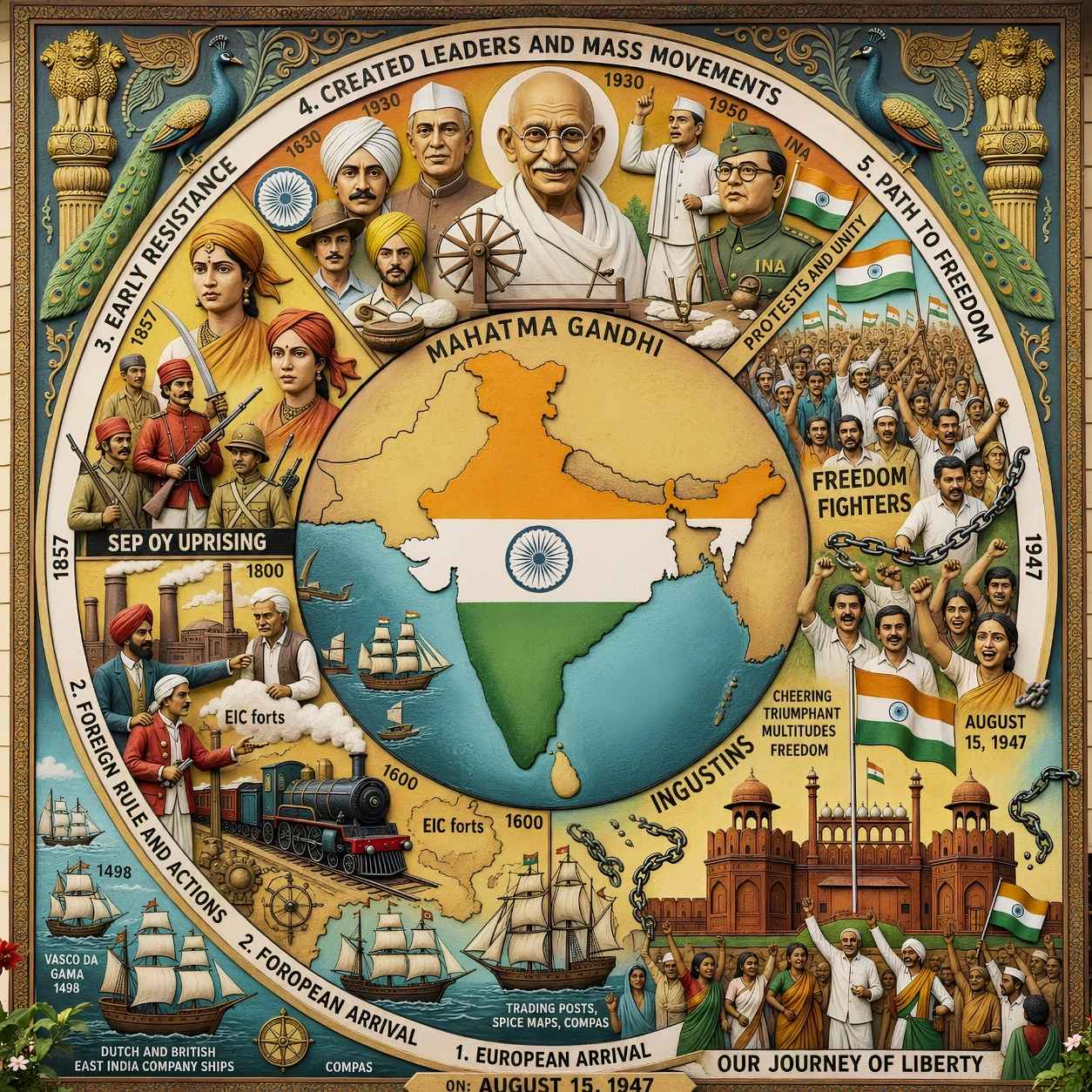
The Epic Saga of Freedom
A masterclass journey through 347 years of resistance. Uncover the unsung rebellions, royal betrayals, armed revolutions, and the unparalleled mass movements that broke the greatest empire in human history.
Scroll to Journey
1600 – 1615
Merchants in the Emperor’s Court
Granted a royal charter by Queen Elizabeth I on New Year’s Eve 1600, the British East India Company (EIC) arrives seeking spices and silk. In 1615, ambassador Sir Thomas Roe bows before Mughal Emperor Jahangir, securing a Farman to build a trading factory in Surat. The silent, corporate invasion begins.
Key Figures
Emperor Jahangir
Sir Thomas Roe
Queen Elizabeth I
1746 – 1763
The Carnatic Wars: Europeans Clash
The British and French East India Companies wage proxy wars in Southern India, manipulating local Nawabs. The French Governor Dupleix’s grand imperial dreams are shattered by British clerk-turned-commander Robert Clive. The British secure total European monopoly after the decisive Battle of Wandiwash (1760).
Key Figures
Robert Clive
François Dupleix (French)
1757 & 1764
Treachery at Plassey & Buxar
Robert Clive defeats Nawab Siraj-ud-Daulah at Plassey (1757) purely through the bribery of general Mir Jafar. The true military victory comes at Buxar (1764), forcing the Mughal Emperor to grant the EIC Diwani Rights. The company now legally taxes Indians to buy Indian goods. The “Drain of Wealth” begins.
Key Figures
Siraj-ud-Daulah
Mir Qasim
Shah Alam II
1770 – 1793
Famine & The Permanent Settlement
Brutal EIC taxation policies trigger the catastrophic Bengal Famine of 1770, wiping out a third of the population (10 million dead). Ignoring the suffering, Lord Cornwallis introduces the Permanent Settlement in 1793, creating a class of exploitative Zamindars (landlords) who squeeze peasants to enrich the British.
Key Figures
Lord Cornwallis
Warren Hastings
1767 – 1799
The Tigers of Mysore
Hyder Ali and his brilliant son Tipu Sultan fight four relentless Anglo-Mysore wars. Tipu builds a modern economy and deploys the world’s first iron-cased combat rockets, terrifying British forces. He refuses to surrender, dying sword in hand defending his capital, Srirangapatna, in 1799.
Key Figures
Hyder Ali
Tipu Sultan
1801 – 1849
The Fall of the Great Empires
The British systematically dismantle the last remaining sovereign powers. The mighty Maratha Empire falls after three grueling wars, ending with the exile of Peshwa Baji Rao II in 1818. After the death of Maharaja Ranjit Singh, the fiercely independent Sikh Empire is annexed in 1849. The subcontinent is entirely conquered.
Key Figures
Maharaja Ranjit Singh
Rani Jindan
Lord Dalhousie
1780 – 1855
Unsung Heroes & Tribal Rebellions
Resistance burned long before 1857. Queen Velu Nachiyar pioneered human bombs against EIC arsenals (1780). The warrior Paikas of Odisha rebelled against land grabs in 1817. In 1855, over 30,000 tribal Santhals, armed only with bows, launched a massive war against modern British rifles and corrupt landlords.
Key Figures
Rani Velu Nachiyar
Bakshi Jagabandhu
Sidhu & Kanhu Murmu
1857 – 1858
The First War of Independence
Angered by the Doctrine of Lapse and greased rifle cartridges, Indian sepoys mutiny in Meerut. The revolt unites Hindus and Muslims, royals and peasants. Despite heroic sacrifices by leaders like Rani Lakshmibai and Tatya Tope, it is brutally crushed. The EIC is dissolved; the British Crown assumes direct imperial rule.
Key Figures
Mangal Pandey
Rani Lakshmibai
Bahadur Shah Zafar
Veer Kunwar Singh
1885 – 1907
Birth of INC & Swadeshi Movement
The Indian National Congress forms in 1885 to seek political rights. In 1905, Viceroy Curzon deliberately partitions Bengal to divide Hindus and Muslims. India retaliates with the Swadeshi Movement, making bonfires of British cloth. A fiery new “Extremist” trio (Lal-Bal-Pal) demands immediate Swaraj.
Key Figures
Dadabhai Naoroji
Lal-Bal-Pal
Lord Curzon
1914 – 1918
WWI, The Ghadarites & Gandhi’s Return
1.3 million Indians fight in WWI, hoping Britain will grant self-rule in return. Meanwhile, the expatriate Ghadar Party attempts an armed uprising in Punjab. In 1915, Mahatma Gandhi returns from South Africa, introducing an entirely new weapon of mass mobilization to the Indian masses: Satyagraha.
Key Figures
Kartar Singh Sarabha
Mahatma Gandhi
1919 – 1922
Jallianwala Bagh & Non-Cooperation
In 1919, General Dyer orders troops to fire on an unarmed, peaceful crowd at Jallianwala Bagh, massacring hundreds. The nationwide horror merges with the Khilafat Movement, leading Gandhi to launch the Non-Cooperation Movement. Millions boycott schools and courts, shaking the empire until Gandhi halts it in 1922 due to violence.
Key Figures
Mahatma Gandhi
Ali Brothers
General Dyer
1925 – 1931
The Fire of the Youth (HSRA)
Disillusioned by the halt of non-cooperation, fierce young revolutionaries form the HSRA. They execute the Kakori Train robbery, assassinate J.P. Saunders (avenging Lala Lajpat Rai), and drop smoke bombs in the Central Assembly. Icons like Bhagat Singh kiss the gallows with a smile, becoming immortal youth legends.
Key Figures
Bhagat Singh
Chandrashekhar Azad
Ram Prasad Bismil
Sukhdev & Rajguru
1930
Purna Swaraj & The Salt March
Declaring Purna Swaraj (Complete Independence), the INC authorizes mass civil disobedience. Gandhi brilliantly targets the universally hated British salt tax, marching 240 miles to Dandi to make his own salt. This simple act sparks nationwide defiance. Sarojini Naidu leads a brutal, entirely non-violent raid on the Dharasana salt works.
Key Figures
Mahatma Gandhi
Jawaharlal Nehru
Sarojini Naidu
1935 – 1939
Elections & World War II
The Government of India Act (1935) grants limited provincial autonomy. The INC sweeps the 1937 elections, proving their mass support. However, in 1939, Viceroy Linlithgow unilaterally drags India into World War II without consulting Indian leaders. In protest, all INC provincial ministries resign en masse.
Key Figures
Jawaharlal Nehru
Sardar Patel
Viceroy Linlithgow
1942
“Do or Die”: Quit India
Following the failure of the Cripps Mission, Gandhi delivers the ultimate ultimatum: “Do or Die.” The British arrest the entire Congress leadership overnight. Undeterred, the leaderless nation erupts into a massive underground rebellion. Parallel independent governments are established in places like Ballia and Satara.
Key Figures
Mahatma Gandhi
Aruna Asaf Ali
Usha Mehta (Secret Radio)
1943 – 1945
Netaji & The Azad Hind Fauj (INA)
Subhas Chandra Bose escapes British surveillance, traveling to Germany and Japan. He establishes the Provisional Government of Free India in Singapore and leads the Indian National Army (INA) toward Delhi. The subsequent post-war Red Fort trials of INA officers ignite a massive wave of patriotism and anti-British fury across India.
Key Figures
Netaji Subhas Chandra Bose
Capt. Lakshmi Sahgal
Shah Nawaz Khan
1946
The Naval Mutiny & Direct Action
The fatal blow is struck not by politicians, but by 20,000 sailors of the Royal Indian Navy who mutiny across 78 ships. Realizing they have lost control of the armed forces, the panicked British send the Cabinet Mission to negotiate a transfer of power. Tragically, political deadlocks lead to horrific communal riots during Direct Action Day.
Key Figures
M.S. Khan
Sardar Patel
M.A. Jinnah
August 15, 1947
Freedom at Midnight
Despite the profound tragedy and bloodshed of Partition, India awakes to life and freedom. At the stroke of the midnight hour, Jawaharlal Nehru delivers his iconic “Tryst with Destiny” speech. Sardar Vallabhbhai Patel embarks on the Herculean task of uniting 565 princely states, while Dr. B.R. Ambedkar prepares to frame the Constitution of the world’s largest democratic republic.
Architects of Modern India
Mahatma Gandhi
Jawaharlal Nehru
Sardar Vallabhbhai Patel
Dr. B.R. Ambedkar

79 Years of Freedom