

No products in the cart.








FindHolidays Heritage Guide · Temple Architecture
A Tale of Two Kailashas: From Stacking Stones to Carving Mountains
Discover how a mesmerising Pallava masterpiece built in Kanchipuram inspired a Rashtrakuta King to chisel away 200,000 tonnes of solid rock, creating the world’s largest monolithic structure at Ellora.
How do you recreate architectural perfection? Do you carefully assemble it from the ground up, stone by stone, or do you daringly carve it out of a single mountain from the top down?
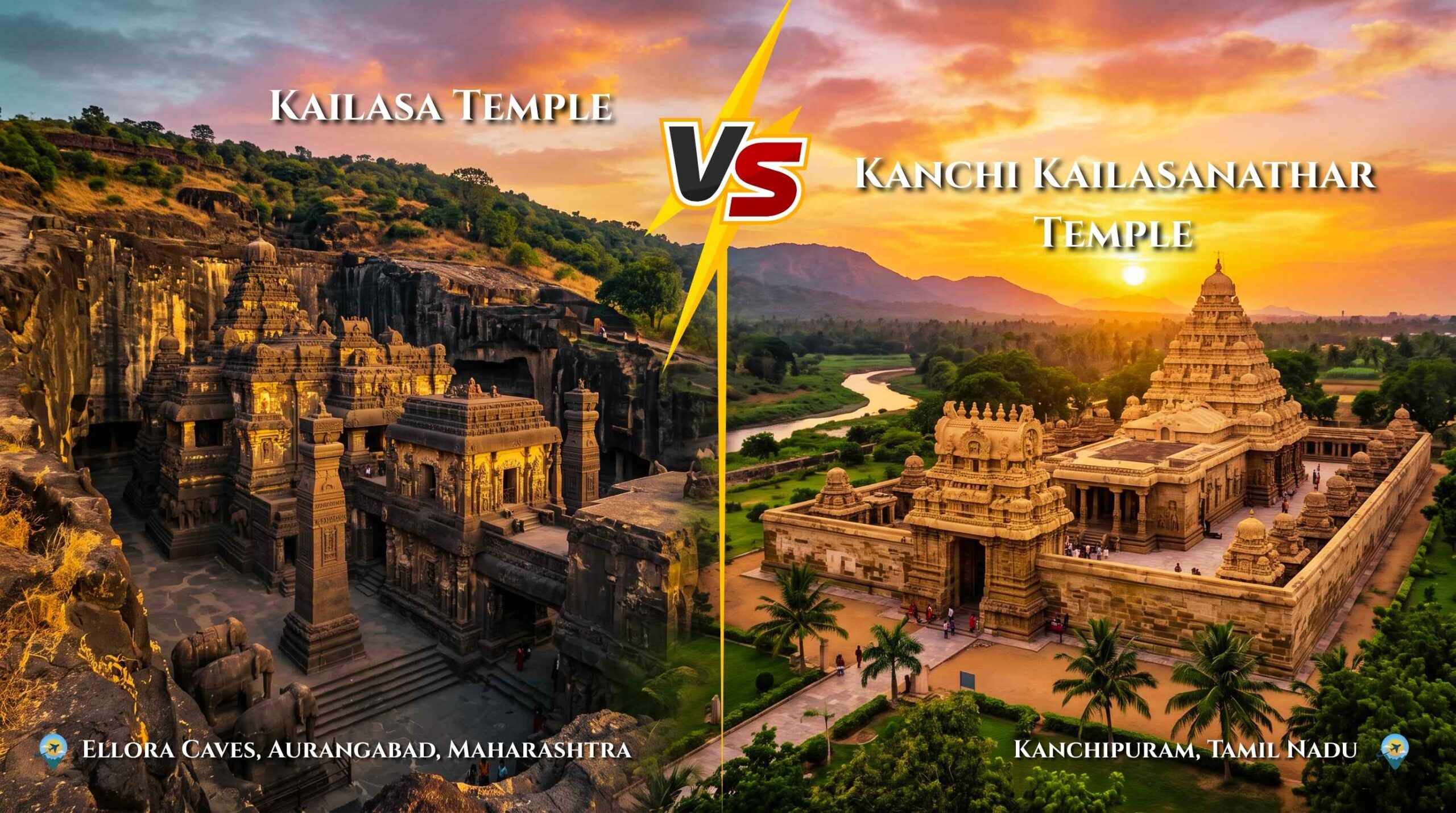
Imagine standing before a structure so magnificent that an invading king stops in his tracks, lowers his weapons, and decides not to destroy it, but to recreate it. This is the exact story that binds two of India’s greatest architectural marvels: the Kanchi Kailasanathar Temple in South India and the Kailasa Temple (Cave 16) at Ellora in Western India.
As Chennai-based travel experts at FindHolidays, we are constantly asked by history enthusiasts to map out the perfect heritage trail. While a weekend getaway from Chennai easily takes you to the Pallava origins in Kanchipuram, understanding the full scope of this architectural evolution requires a journey across dynasties. Here is the incredible story of how the Pallavas perfected the Dravidian style, and how the Rashtrakutas mirrored it by doing the impossible.
The Blueprint: Kanchi Kailasanathar Temple
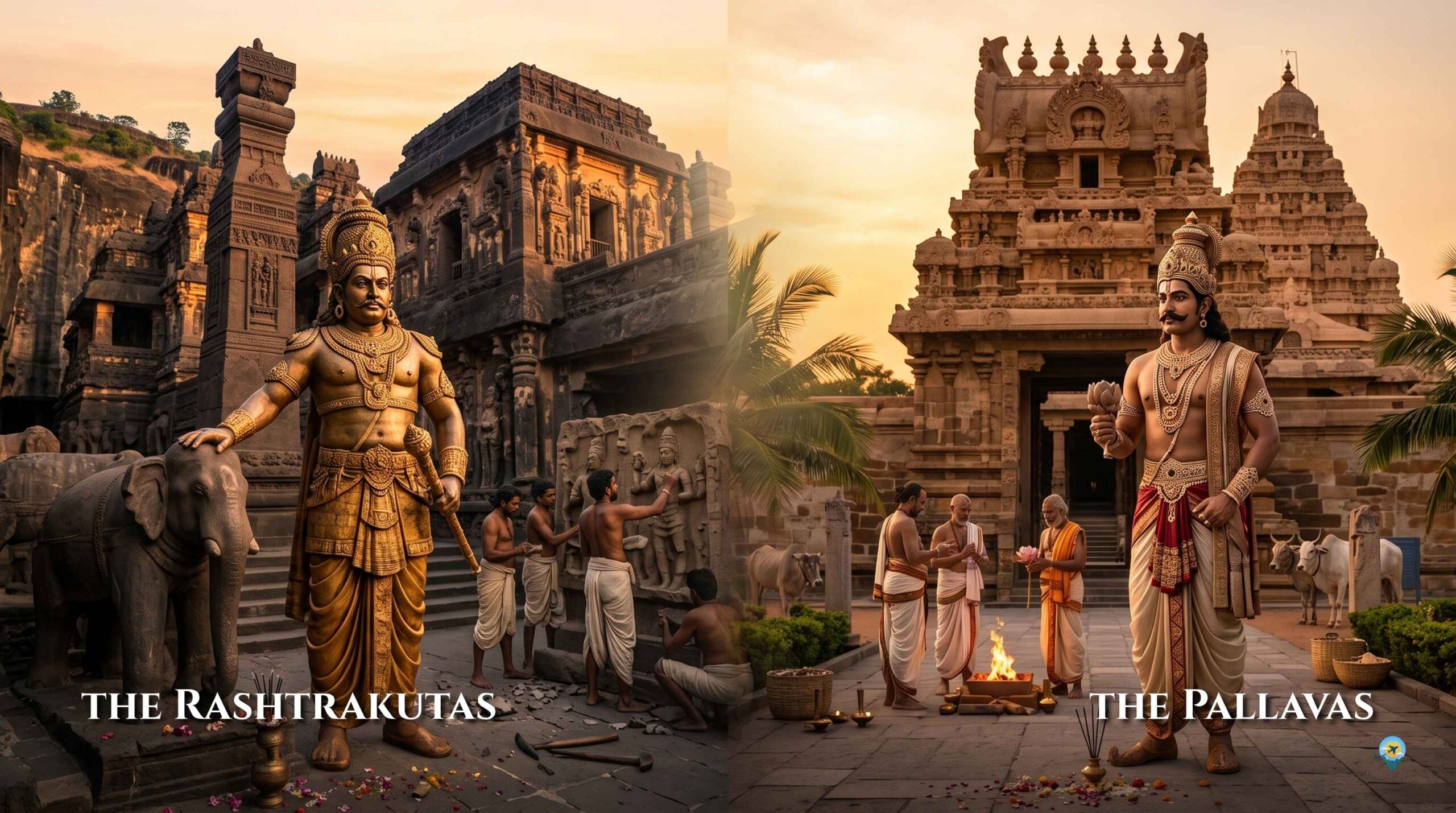
In the vibrant temple town of Kanchipuram, just a short drive from Chennai, King Narasimhavarman II (also known as Rajasimha) of the Pallava Dynasty set out to build a masterpiece around 700 CE. At the time, early temples were carved into caves (like those in Mahabalipuram). But the King wanted a sprawling, standalone urban complex to dedicate to Lord Shiva.
He achieved this by introducing a structural method—stacking soft, easily carved sandstone upon a sturdy, load-bearing granite foundation. This allowed the Pallavas to perfect the quintessential Dravidian architectural style: a multi-storeyed vimana (tower), beautifully carved pillared halls, and an enclosed courtyard adorned with countless shrines. It was an unprecedented leap in structural engineering.
It was a masterpiece of urban planning and divine symmetry that would soon change the course of history over a thousand kilometres away.
The Audacity: Carving a Mountain at Ellora
Fast forward roughly 50 years. The Rashtrakuta Empire, under King Krishna I, expanded their territories. History tells us that upon witnessing the Kanchi temple, the King was so mesmerised by its multi-storeyed layout and elaborate courtyard design that he vowed to build an even grander version in his own kingdom at Ellora.
But King Krishna I did not want a traditional structural temple. He wanted to make a statement of absolute dominance and devotion. Instead of quarrying stones and stacking them up, his architects selected a solid basalt cliff face. They began chiselling from the top of the mountain downwards, carefully hollowing out the rock to reveal a multi-storeyed temple already “hidden” inside. They excavated over 200,000 tonnes of volcanic rock with basic chisels and hammers. A single mistake would have ruined the entire structure, as you cannot put a carved rock back.
A Tale of Two Marvels: The Core Differences
While one inspired the other, the execution of these two temples places them in entirely different architectural leagues.
The Construction Method
Kanchi: Structural. Stones were quarried elsewhere, brought to the site, and stacked from the ground up.
Ellora: Monolithic Rock-Cut. Excavated entirely from the top-down out of a single living rock face. No stones were added; everything was revealed by removal.
The Primary Material
Kanchi: Built using a combination of soft Sandstone (for intricate carvings) resting on a solid Granite base to prevent structural sinking.
Ellora: Carved out of Hard Volcanic Basalt Rock. The sheer density of the basalt makes the intricate carvings and unsupported balconies an engineering miracle.
Unique Feature: The Kanchi Crawl
Kanchi: Features the famous “Path of Moksha” (Salvation) tunnel. Devotees must crawl through a narrow, dark, and winding passage around the sanctum, symbolising the cycle of birth, life, and the difficult journey to liberation.
Unique Feature: The Ellora Scale
Ellora: Features a gigantic, excavated courtyard filled with life-sized, free-standing carved stone elephants and a massive victory pillar. All of these remain attached to the original bedrock floor.
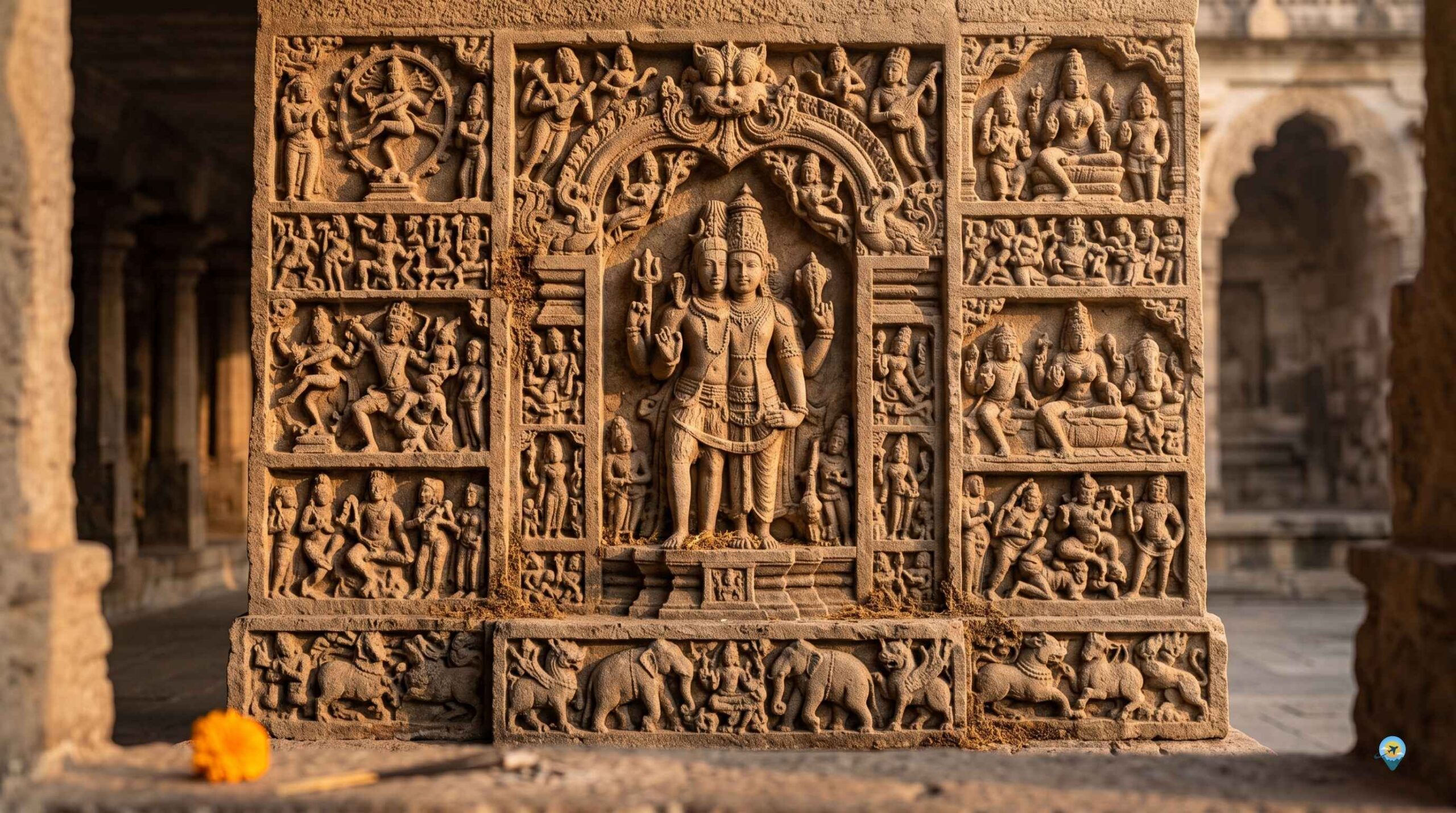
At a Glance: The Kailashas Compared
For quick reference when planning your heritage tours with FindHolidays, here is how the two temples stack up.
| Feature | Kanchi Kailasanathar Temple | Kailasa Temple (Cave 16) |
|---|---|---|
| Location | Kanchipuram, Tamil Nadu (South India) | Ellora Caves, Aurangabad, Maharashtra |
| Creator / Dynasty | King Narasimhavarman II (Pallava) | King Krishna I (Rashtrakuta) |
| Timeline | Built around 700 CE (Older) | Built around 756–773 CE (~50 years later) |
| Scale & Setting | Compact, standalone urban complex | The largest monolithic structure on Earth |
| Construction Method | Structural (Stacking stones) | Monolithic (Carved from a single cliff) |
The FindHolidays I.N.D.I.A. Travel Framework
Planning to visit both of these architectural wonders? Whether you are starting from Chennai or elsewhere, use our I.N.D.I.A. compass to plan seamlessly.
Itinerary Start
Begin in Chennai. Take a 2-hour morning drive to Kanchipuram to see the original blueprint before the afternoon heat sets in.
Navigation
To reach Ellora, book a flight from Chennai to Aurangabad (often via Hyderabad or Mumbai). The caves are a 45-minute drive from Aurangabad airport.
Dress Code
Both are revered historical and religious sites. Modest clothing covering shoulders and knees is highly recommended for respectful exploration.
Insider Guides
The stories are hidden in the stones. Always book an ASI-approved guide (or let FindHolidays arrange an expert) to decode the mythological panels.
Architecture Pace
Do not rush. Kanchipuram requires at least half a day. Ellora (which houses 34 caves in total) requires a full, dedicated day of walking.
Four Heritage Holiday Styles
Depending on your time and interests, FindHolidays can customise these historical routes for you.
1. The Pallava Day Trip
Perfect for Chennai locals. A curated 1-day drive covering the Mahabalipuram shore temples and the Kanchi Kailasanathar Temple.
2. The Deccan Time Travel
A 4-day trip to Maharashtra focusing purely on the rock-cut wonders of Ajanta and Ellora, based out of Aurangabad.
3. The Grand Architecture Trail
An epic 7-day journey spanning Tamil Nadu and Maharashtra to see the evolution of the Dravidian style from stacked stone to carved mountain.
4. The South Indian Spiritual
A deep dive into Tamil Nadu’s temple towns: Kanchipuram, Mahabalipuram, Chidambaram, and Thanjavur.
The Perfect Visitor Timeline
Make the most of your architectural exploration with this approach.
Step 1
Morning at Kanchi
Visit the Kanchi temple just after sunrise. The morning light hitting the sandstone carvings is a photographer’s dream. Walk the circumambulatory path.
Step 2
The Path of Moksha
If you are physically able, experience the crawling tunnel at Kanchi. It is a profound, physical metaphor for spiritual liberation.
Step 3
The Descent into Ellora
When visiting Cave 16 at Ellora, do not just walk in. Climb the hill path *above* the cave first to look down at the roof. It is the only way to truly comprehend the top-down carving method.
Step 4
The Elephant Courtyard
Descend into the Ellora courtyard. Stand beside the life-sized monolithic elephants to grasp the unbelievable scale of the rock removed.
Common Temple Travel Mistakes to Avoid
1. Skipping the Guides
Looking at the carvings is one thing; understanding the stories of the Ramayana and Mahabharata etched into them is another. You miss 80% of the experience without a knowledgeable guide.
2. Underestimating the Walk
The Ellora cave complex spans over 2 kilometres. Wear comfortable, slip-on walking shoes (as you will remove them often for active shrines) and carry plenty of water.
3. Missing the Sub-shrines
At Kanchipuram, visitors often rush to the main sanctum. Take time to explore the 58 small Shiva shrines built into the inner wall of the courtyard.
4. Wrong Time of Day
Avoid visiting these open-air stone complexes between 12 PM and 3 PM. The stone floors heat up significantly under the Indian sun, making barefoot walking uncomfortable.
Plan Your Trip with Reliable Information
This blog is an educational travel-planning guide by FindHolidays. Monument access timings, ASI ticket prices, and flight schedules change based on the season. Always verify current information or let our team handle the logistics for you.
Frequently Asked Questions
Can I visit both Kanchipuram and Ellora in one trip?
Yes, though they are in different states. The best way is to spend 1-2 days in Chennai/Kanchipuram, then take a flight from Chennai to Aurangabad (often a connecting flight) to explore Ellora over the next 2 days.
Which temple is older?
The Kanchi Kailasanathar Temple is older. It was built around 700 CE by the Pallavas. The Kailasa Temple at Ellora was built about 50 years later, around 756–773 CE, by the Rashtrakutas.
Is it true Ellora was carved from the top down?
Yes, it is an architectural marvel. To avoid using scaffolding and hauling stones, the Rashtrakuta artisans started at the top of the cliff and carved downwards, removing 200,000 tonnes of rock to reveal the temple within.
How far is Kanchipuram from Chennai?
Kanchipuram is approximately 75 kilometres from Chennai. Depending on traffic, it is a comfortable 1.5 to 2-hour drive, making it an ideal day trip from the city.
Do I need to book tickets in advance for Ellora?
While you can buy tickets at the counter, we highly recommend purchasing Archaeological Survey of India (ASI) tickets online via their portal or having your travel agent book them to avoid long queues during peak tourist seasons.
Ready to Explore India’s Greatest Temples?
From the sandstone carvings of Kanchipuram to the breathtaking monolithic rock cuts of Ellora, India’s heritage is waiting to be explored. Let the FindHolidays team in Chennai craft a seamless, stress-free historical itinerary for you and your family.
FindHolidays · Anna Nagar, Chennai, Tamil Nadu · info@findholidays.in · +91 99425 49191